Why I Love the Feelings Wheel
(and how it can help you too)
One of my favorite tools to introduce to people is the feelings wheel (linked here).
The truth is, many of us don’t really know how to name what we’re feeling. And that’s okay. A lot of us were never taught how.
Maybe you grew up hearing things like “you’re fine,” “don’t be so sensitive,” or “calm down.” Maybe emotions weren’t talked about much in your home, or maybe they were overwhelming and confusing. Whatever the reason, many adults move through life with only a few emotional words in their vocabulary: good, bad, stressed, fine.
But our emotional world is much richer than that. Learning to identify our feelings is one of the most important skills we can develop for our overall mental health and relationships.
That’s where the feelings wheel comes in.
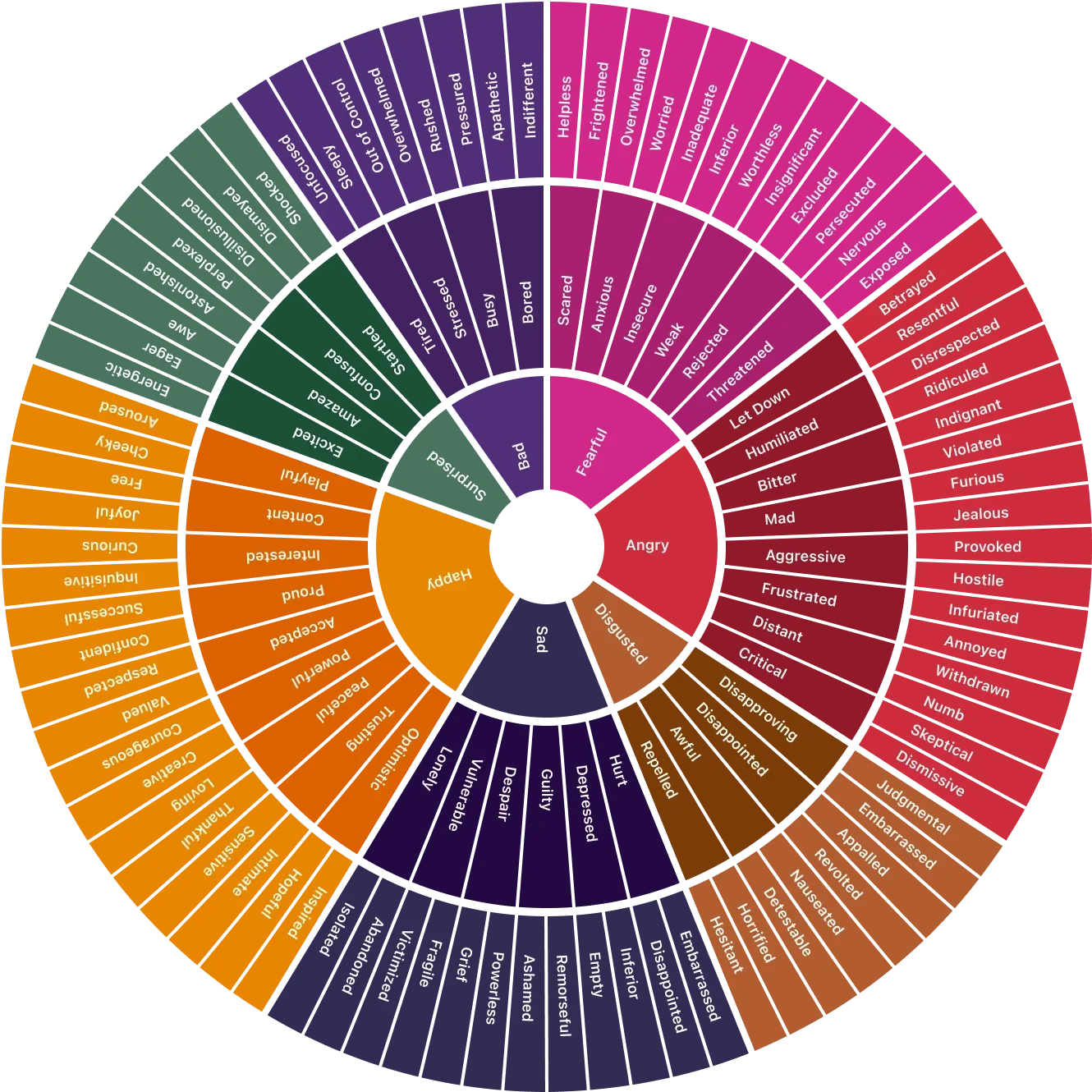
What is it?
The feelings wheel (originally created by Dr. Gloria Willcox in 1982) is a visual tool that organizes emotions in a circle (or wheel). It helps us move from broad, general feelings to more specific ones.
The center contains core emotions like happy, sad, angry, fearful, surprised, and disgusted.
The middle layer expands into more specific feelings connected to those core emotions.
The outer layer becomes even more detailed and precise.
For example, you might start by noticing you feel angry. But when you look at the wheel, you might realize the feeling is actually frustrated, hurt, resentful, or disrespected.
[Image taken from feelingswheel.com]
Why Learning to Name Feelings Matters
I often tell people that you can’t work with an emotion if you don’t know what it is.
An important note: feelings are not “good” or “bad.” We tend to label them as such, but that often just stigmatizes what we are feeling. Emotions are informative signals that usually serve a purpose. Anger might point to a boundary being crossed. Sadness can signal a loss that needs attention. Anxiety can alert you to something important that needs preparation. For example, the nerves you are feeling before a big test signal the importance of studying the material so you can show up prepared.
When we can identify what we’re truly feeling, we start to understand ourselves better.
Naming emotions helps us:
understand what we need
communicate more clearly with others
respond instead of react
feel less overwhelmed by what’s happening inside us

Sometimes just finding the right word for a feeling can bring a surprising amount of relief.
The beloved Pixar movie, Inside Out, does a fantastic job showing how different emotions work together inside us. I highly recommend a watch (or a rewatch!). It’s a playful, easy-to-understand reminder that every emotion has a role and a purpose.
How to Use the Feelings Wheel
Pause and check in with yourself. Ask, “What am I feeling right now?”
Start in the center of the wheel. Which core emotion seems closest?
Move outward. Look at the more specific emotions connected to that core feeling.
Choose the word that fits best. There may be more than one — that’s normal!
Reflect. Ask yourself what might be causing that feeling and what you might need.
For example, you might initially think you feel sad, but the wheel might help you realize the deeper feeling is lonely, disappointed, or rejected.
When to Use the Feelings Wheel
The feelings wheel can be helpful anytime you want to better understand your emotional experience.
Some moments when it can be especially useful include:
when you feel overwhelmed but can’t explain why
during journaling or reflection
in conversations when you’re trying to express how you feel
in therapy or personal growth work
when helping children learn about their own emotions
Sometimes I recommend simply checking in with the wheel at the end of the day and asking yourself, “What emotions showed up for me today?”
If identifying emotions feels hard, you’re not alone.
So many of us were never taught how to do this. Emotional awareness is a skill, and like any skill, it takes practice. The goal isn’t to get it perfect — it’s just to become more curious about what’s happening inside you.
I love this tool because it takes something that can feel overwhelming and makes it simple and accessible. (I also love that it’s brightly colored and pretty to look at!) It reminds us that emotions aren’t something to avoid or ignore. They are signals that help us understand ourselves. Every emotion serves a purpose, and learning to identify them helps us respond with care rather than judgment.
The more we practice identifying and naming our feelings, the more connected we become to our own experiences and to the people around us.
So, try it out! See what you notice. This website makes it super simple to click through the emotions and identify the root. You got this!
Thanks for reading! If you are interested in learning more about working with me, I would love to hear from you! Reach out today!
